New book · Coming soon
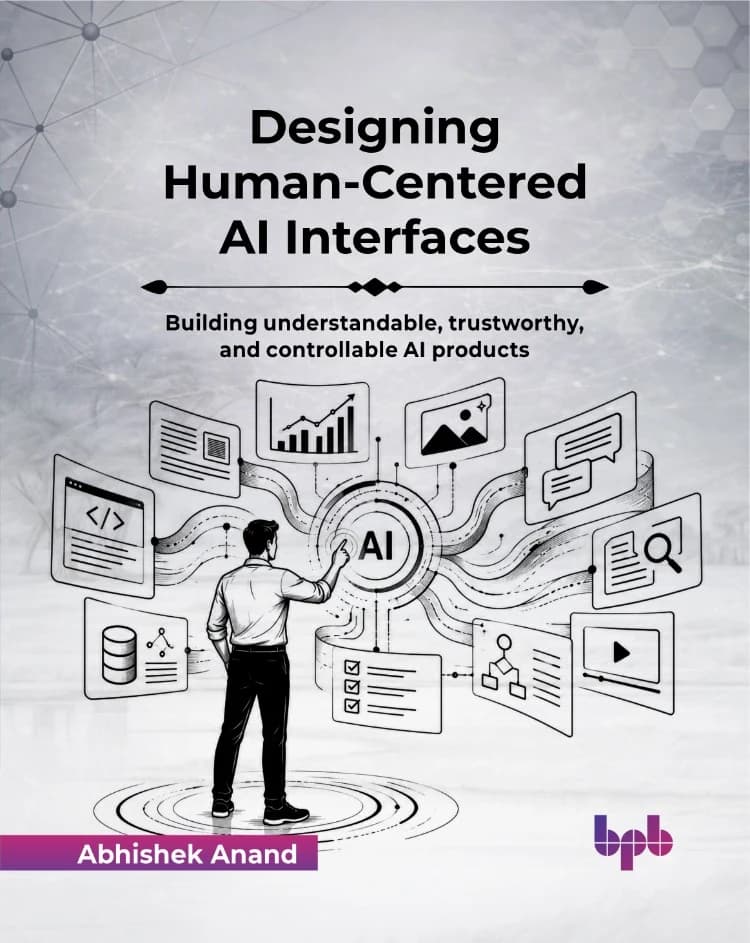
Designing Human-Centered AI Interfaces
Building understandable, trustworthy, and controllable AI products
Paperback and ebook · 16chapters · BPB Publications
About the book
AI is probabilistic. Your interface has to account for it.
A few years ago, generative AI was a novelty. Today it sits inside the products we use every day. The systems we ship now are probabilistic, which means the same input does not always produce the same output. That single shift changes how users decide what to trust, how they recover from mistakes, and how much control they feel they have.
This book is a practical, design-first guide to building AI products that people can understand, trust, and direct. It covers foundations and mental models for probabilistic systems, followed by a library of interaction patterns for inputs, outputs, explainability, steerability, recommendations, memory, agents, multimodal experiences, and high-stakes domains like healthcare and finance. It also explores practical approaches to delivery, including prototyping with live models, scaling patterns through a design system, handing off to engineering, and where the field is heading next. Case studies are drawn from Spotify, GitHub Copilot, Perplexity, and other widely used products.
By the end, you will have the frameworks, checklists, and handoff templates to design, prototype, and evaluate AI features with confidence, collaborate well with engineering and data science, and ship products that are not only technically advanced but also ethical, accessible, and centered on human needs.
What you will learn
Patterns you can put into a product.
- 01Master practical patterns for prompts, feedback, and explainability
- 02Design steerable, interruptible UX that keeps humans in control
- 03Visualize uncertainty and turn AI errors into trustworthy moments
- 04Apply evaluation rubrics for usefulness, accuracy, safety, and delight
- 05Build citations, provenance, and transparency directly into the interface
- 06Scale AI patterns through design systems with consistent governance
- 07Hand off to engineering with data contracts and guardrails
- 08Prototype, test, and measure AI features using live models
Contents
Sixteen chapters.
- 1Modern AI UX Landscape
- 2AI Fundamentals for Designers
- 3Human-centered AI for Trust and Transparency
- 4Designing AI Inputs
- 5Designing AI Outputs
- 6Explainability in the Interface
- 7Steerability and Interruptibility in AI Interfaces
- 8Designing Recommendation and Personalization Engines
- 9Memory and User Profiles in Conversational AI
- 10Agent UX for Goals, Plans, and Safe Autonomy
- 11Multimodal Interfaces
- 12AI UX for Safety, Compliance, and Ethics
- 13Prototyping and Evaluating AI UX
- 14AI in Design Systems and Scaling Patterns
- 15Handoff to Engineering
- 16Future Trends in AI Interaction
Who it is for
This book is for product designers, UX professionals, UI designers, HCI researchers, and design leaders building AI-powered products. It is also useful for product managers seeking a design-oriented view of AI and front-end engineers collaborating with design teams. Familiarity with digital product design is recommended; a machine learning background is not required.
About the author
Abhishek Anand is a senior UX engineer with seventeen years of experience shaping digital products at the intersection of design and engineering. Across a career spanning Google, Acquia, and MakeMyTrip, he has learned that the hardest problems in technology are rarely only technical. They are human.
His recent work centers on AI-powered experiences, agentic workflows, and research-driven UX: how interfaces can help people understand intelligent behavior, set the right expectations, and remain in control.
Coming soon
Be first to read it.
Leave your email and I’ll send one note on launch day with links to the paperback and ebook.
The views in this book are my own and do not represent the position, policy, or endorsement of Google LLC or its affiliates.